Why Smart Router?
RPC proxies have been built in-house thousands of times — along with the failover, caching, and monitoring that surround them. Smart Router is that layer as a standard, actively maintained component.
Instead of building and maintaining your own RPC proxy, you get multi-chain support across EVM and non-EVM networks, automatic failover, data cross-validation, built-in observability, caching, and more.
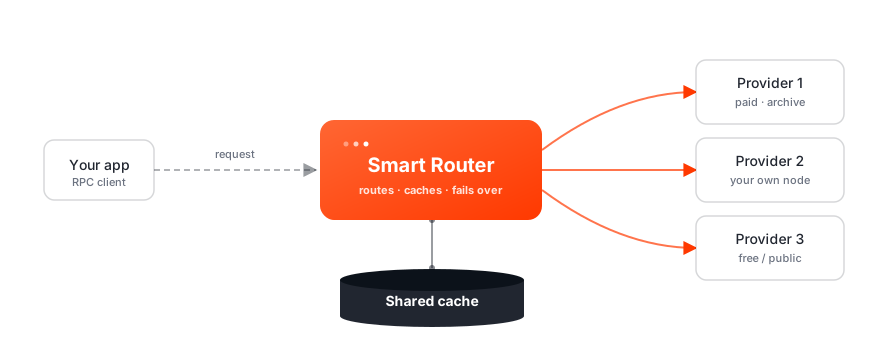
Failover
Smart Router's failovers kick in under different scenarios, or "incidents" — for example, if an upstream is unavailable, returns errors, returns stale data, takes too long, or times out.
Cross-validation
Reads can be sent to several upstreams in parallel and returned successfully only once the quorum criteria are reached. This stops conflicting or potentially malicious responses from flowing downstream.
Caching
A block-aware cache serves repeat reads without hitting an upstream, while avoiding serving stale data. It can be shared across router replicas, significantly reducing upstream calls and latency.
Transaction broadcasting
Write methods (eth_sendRawTransaction and equivalents) are broadcast to all eligible upstreams in parallel to increase the success rate and speed of transactions.
Multi-chain
Serves all standard blockchain API formats: JSON-RPC, REST, gRPC, Tendermint, and WebSocket. Supports EVM chains, Solana, UTXO chains, Cosmos chains, and other custom networks. Chains are defined by JSON specs, so adding one requires no code change.
Observability
Prometheus metrics, OpenTelemetry traces, structured logs, and a typed error taxonomy cover the full request lifecycle — along with a prebuilt dashboard for easy, immediate observability out of the box.
Observability → · Metrics → · Dashboard →
Enterprise
These docs cover the self-hosted, source-available edition. Enterprise support, SLAs, and custom features are available under a separate license.