Cross-validation
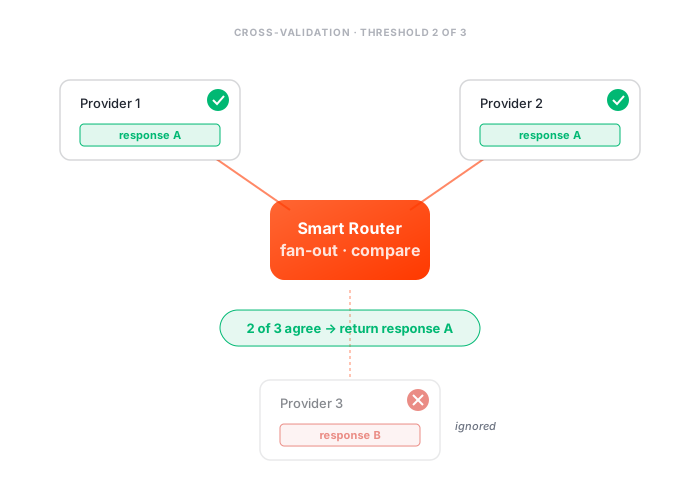
Send the same request to multiple RPC nodes in parallel and require agreement before returning the response. Catches one-off lying or buggy nodes before bad data reaches your client. (Also called consensus — the two terms are used interchangeably here.)
How it works
When cross-validation is active for a relay:
- Smart Router fans the request out to
MaxParticipantsnodes in parallel. - Responses are collected as they arrive.
- As soon as
AgreementThresholdnodes return matching responses, that response is returned. - If nodes disagree past the timeout, the relay fails or returns the most-agreed answer (depending on configuration).
| Parameter | Meaning |
|---|---|
MaxParticipants |
how many nodes to query in parallel |
AgreementThreshold |
how many must match before the response is accepted |
Default values are {MaxParticipants: 1, AgreementThreshold: 1} — i.e., effectively disabled. Cross-validation is opt-in per relay rather than always-on, because it multiplies upstream cost.
When to use it
| Scenario | Cross-validate? |
|---|---|
| Critical writes (token transfers, contract calls) | yes — but check responses, not just submission acks |
| Indexer-style reads of finalized data | optional — cache hit rate already absorbs most cost |
eth_getLogs results that downstream code depends on |
yes — nodes commonly disagree on log ordering |
debug_* traces |
yes if you don't trust a single node |
eth_call against contracts at fixed block |
yes — deterministic, easy to compare |
eth_call against pending block |
no — non-deterministic by definition |
eth_blockNumber / latest block reads |
no — nodes will naturally disagree by 1 block |
Configuration
Cross-validation can be turned on two ways, resolved together per request in cross_validation_policy.go:
1. Per-request, by the client. Send both headers and the router cross-validates that single request:
See Directives. The router returns the outcome on the response headers (lava-cross-validation-status, lava-cross-validation-agreeing-providers, and on failure lava-cross-validation-failure-reason).
2. Operator policy. An operator can mandate cross-validation for a (chain, interface, method) — setting floors and caps — or forbid clients from requesting it for a method. Policies live in a top-level cross-validation block in the smart router config file:
cross-validation:
  policies:
    # Mandate consensus for a sensitive read, capped so clients can't fan out wider.
    - chain-id: "ETH1"
      api-interface: "jsonrpc"
      method: "eth_getLogs"
      enabled: true
      agreement-threshold: { floor: 2 }
      max-participants: { floor: 3, cap: 5 }
    # Forbid clients from cross-validating a non-deterministic method.
    - chain-id: "ETH1"
      api-interface: "jsonrpc"
      method: "eth_blockNumber"
      forbid-caller-cv: true
When an enabled policy applies, each knob is clamp(caller-or-floor, floor, cap): a client may raise MaxParticipants above the floor but can't shrink the quorum below the operator's minimum. forbid-caller-cv disables cross-validation for the method even when a client sends the headers (mutually exclusive with enabled). See the config-file reference for the full field list.
Each bound takes { floor, cap }, but a bare number is shorthand for a floor with no cap — agreement-threshold: 2 is identical to agreement-threshold: { floor: 2 }. Use it for the common "mandate at least N, no upper bound" case.
Group diversity
A quorum of nodes that all share a vendor, image, or data source can agree on the same wrong answer — so a plain count of agreeing nodes can mask a correlated fault. Group-diversity policies guard against this by requiring the quorum to span multiple independent operator groups.
Groups come from the group-label you set on each provider in the config file (e.g. tier-1, external, a vendor name) — see group-label under direct-rpc. Providers with no label fall into a single default group. Two policy knobs act on them:
| Field | Meaning |
|---|---|
min-groups |
The agreeing nodes must come from at least this many distinct group-labels. |
per-group-quorum |
Require each of min-groups groups to independently reach agreement-threshold (needs min-groups > 1). |
cross-validation:
  policies:
    - chain-id: "ETH1"
      api-interface: "jsonrpc"
      method: "eth_getLogs"
      enabled: true
      agreement-threshold: { floor: 2 }
      max-participants: { floor: 4, cap: 6 }
      min-groups: 2          # the quorum must span ≥ 2 distinct group-labels
      per-group-quorum: true # …and each group must independently agree
Diversity is only as real as your labels: if every upstream carries the same group-label, min-groups can never be satisfied and the relay fails the policy. Label providers by their actual independence — distinct vendors / regions / clients — not by name alone.
Runnable example
The repo ships a ready-to-run multi-chain config that pairs two vendor groups (lava + publicnode) per chain and mandates min-groups: 2 cross-validation on several read methods: config/smartrouter_examples/smartrouter_multichain_cross_validation.yml.
With no operator policy, the caller's headers alone decide; with no headers and no policy, cross-validation is off ({MaxParticipants: 1, AgreementThreshold: 1} is effectively disabled). The CrossValidationParams shape lives in protocol/common/types.go.
Trade-offs
- Cost: a request with
MaxParticipants: 3costs 3× upstream calls. Pair with caching so the multiplier doesn't apply to cache hits. - Latency: the response is gated on the slowest of the agreeing nodes. Combine with hedging to mitigate.
- Determinism: the comparator is response-shape-aware (it knows array order can be normalized for some methods, that some fields are timestamp-based, etc.). Don't expect raw byte equality.
Difference from integrity
- Integrity catches out-of-sync nodes before the relay is sent (pre-request lag check).
- Cross-validation catches wrong responses by comparing across RPC nodes after they return.
You can run both. They aren't mutually exclusive.
Observability
| Metric | Meaning |
|---|---|
smartrouter_cross_validation_requests_total |
cross-validated requests |
smartrouter_cross_validation_success_total / smartrouter_cross_validation_failed_total |
requests that reached / failed to reach consensus |
smartrouter_cross_validation_provider_agreements_total / _provider_disagreements_total |
per-provider agreement / disagreement counts |
smartrouter_cross_validation_mismatch_total |
content outliers by group and finality — post-finality divergence is the high-signal alert |
smartrouter_cross_validation_failures_total |
failures broken down by reason (structural vs. quorum disagreement) |
| Tracing | each fan-out attempt is a parallel span; the comparator's verdict is a span event |
See the Metrics reference for labels and types.